Caching
Caching changes cost, latency, and traffic shape. It is one of the biggest operational differences between a prototype that works and a production integration that scales cleanly.
Why Caching Matters
Repeated context is expensive when it is re-billed as fresh input every time.
Long system prompts, reusable repository context, and repeated instruction scaffolds create the same waste pattern: the model keeps seeing almost identical context, but the caller pays again unless caching is preserved or injected effectively.
Caching is not only about lower cost. It also makes latency and throughput more predictable because the platform can avoid repeated upstream work on stable prompt segments.
How Cache Behavior Differs by Interface and Tool
The most important distinction is whether the request path preserves Anthropic-native cache controls or not.
| Caller | Typical route | Cache behavior |
|---|---|---|
| Cursor | OpenAI-compatible | No explicit Anthropic cache_control fields in the client request. |
| Codex | OpenAI-compatible | No explicit Anthropic cache_control fields in the client request. |
| Claude Code | Anthropic-native | Best fit for preserving Anthropic-native cache semantics. |
| OpenCode with OpenAI adapter | OpenAI-compatible | Depends on platform optimization rather than client-native cache fields. |
| OpenCode with Anthropic adapter | Anthropic-native | Can preserve Anthropic-native cache semantics when supported. |
LingCoreX Cache Optimization
When teams call Anthropic models through the OpenAI-compatible route, LingCoreX can reduce waste by applying automatic Cache injection in stable prompt segments.
OpenAI-compatible callers do not expose Anthropic explicit cache_control fields directly. That would normally create a cost penalty when a coding tool repeatedly resends long stable context to an Anthropic-backed model.
LingCoreX narrows that gap by applying automatic Cache injection in repeated stable regions, especially when the caller uses Anthropic models through the OpenAI-compatible path.
This does not mean every request receives the same savings. Cache effectiveness still depends on prompt stability, repetition, and the upstream model's behavior.
Example Cost Delta
The table below illustrates how large the difference can become when repeated prompt scaffolds are billed fresh every time.
| Scenario | Without explicit caching | With LingCoreX cache optimization |
|---|---|---|
| Shared 25k-token coding scaffold reused across 50 requests | Every request re-bills most of the repeated scaffold as fresh input | Repeated scaffold is partially reused, lowering effective input cost materially |
| Agent workflow with stable system prompt plus repository policy text | High repeated input usage and slower cost ramp-down | Repeated stable regions can be reused instead of billed as fully fresh each time |
Usage and Cost Screenshot
Reserve space for a real chart or dashboard screenshot that compares cached and uncached traffic.
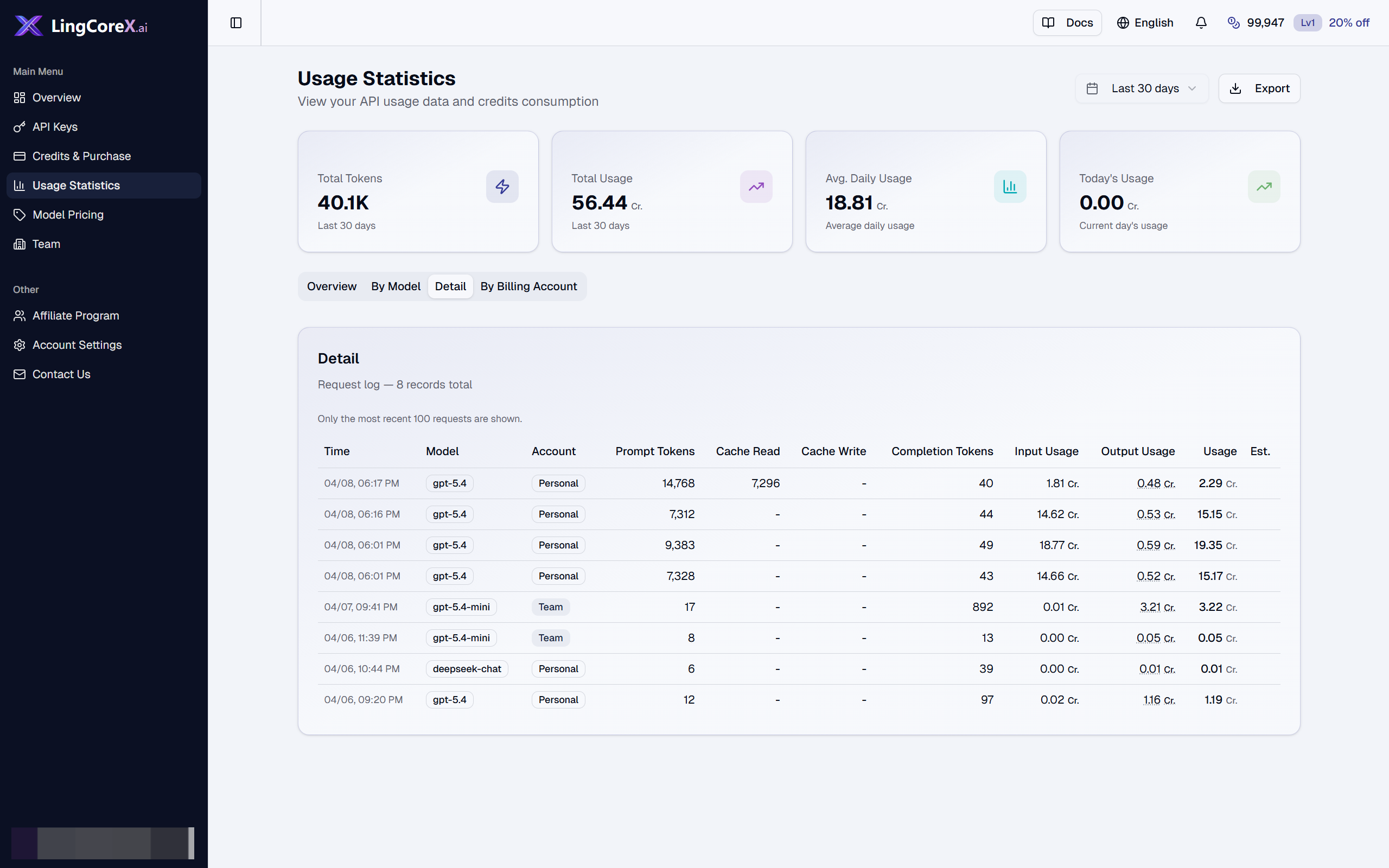
Usage and cost comparison
Shows the usage dashboard context for comparing cache reads, cache writes, and total cost.